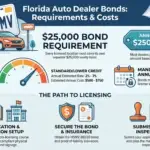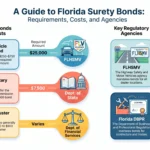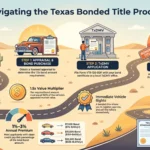

Used car dealer bond requirements are not moving in one direction across every state. Florida is still a $25,000 market, Texas sits at $50,000, Georgia just moved up to $50,000 as of July 1, 2026, and Ohio became an outlier of its own with a jump to $75,000 effective April 1, 2026. That matters because the bond amount does more than check a licensing box. It shapes startup cost, renewal pressure, underwriting scrutiny, and the amount of cash flow stress a dealer can feel when a state raises the floor.
2026 Used Car Dealer Bond Snapshot by State
| State | Required used dealer bond | Term cycle | Why it matters |
|---|---|---|---|
| Florida | $25,000 | Annual; common April 30 expiration | Lowest bond amount in this group, but still a compliance-heavy market. |
| Texas | $50,000 | 2-year term | Higher bond threshold; separate bond/license obligations can apply by county. |
| Georgia | $50,000 (up from $35,000, effective July 1, 2026) | 2-year cycle; renews Sept. 30, even years | New requirement under Georgia SB 293 — existing dealers move up at their Sept. 30, 2026 renewal. |
| Ohio | $75,000 effective April 1, 2026 | Higher requirement rolling in through new licensing and renewal timing | Largest bond in this group and the clearest sign that dealer oversight is getting tougher. |
Florida: still the lightest lift
Florida’s used car dealer bond remains at $25,000 — still the lightest lift in this four-state set. The common expiration date is April 30, and Florida has not signaled any imminent increase.
Texas: bigger bond, longer term
Texas requires a $50,000 used car dealer bond, and the standard bond term is two years. Texas also raised its bond requirement from $25,000 to $50,000 in 2021, so the state has already shown a willingness to increase amounts.
Georgia: moderate amount, fixed cycle
Georgia’s used motor vehicle dealer bond requirement went up on July 1, 2026, from $35,000 to $50,000 under Senate Bill 293. Anyone applying for a new dealer license on or after that date needs the full $50,000 bond in hand before licensing can move forward. Dealers who already hold a $35,000 bond aren’t required to swap it out immediately — Georgia licenses and bonds run on a fixed two-year cycle that renews every other September 30, so existing dealers have until their September 30, 2026 renewal to file the higher amount. That fixed renewal date is worth tracking on its own: because it’s tied to the calendar rather than when a dealer first got licensed, it’s easy to lose track of relative to a bond-amount change like this one. Dealers who also hold a parts license should note that Georgia’s separate Parts bond moved to the same schedule — its renewal shifted from December 31 of odd-numbered years to September 30 of even-numbered years, so it now lines up with the dealer bond instead of running on its own separate clock.
Ohio: the state everyone should watch
Ohio is now the clearest warning sign in the used dealer bond market. Effective April 1, 2026, the required used dealer bond moved from $25,000 to $75,000. That is a sharp jump, and it changes the economics fast. A dealer who was used to a smaller bond now faces significantly higher premium costs at renewal.
What Rising Used Car Dealer Bond Requirements Mean for Independent Dealers
For independent dealers comparing states, the practical ranking is simple: Florida is the lightest lift, Georgia is the middle ground, Texas is materially heavier, and Ohio is now the highest-friction market in this group. That ranking affects three real things: Understanding your used car dealer bond options across all four states helps you plan renewals, budget costs, and avoid last-minute surprises.
- Cost, because premium usually scales with bond amount and applicant strength.
- Operational pressure, because fixed expirations and renewal cycles create admin risk if they are missed.
- Expansion planning, because a dealer adding states may move from a $25,000 compliance mindset into a $50,000 or $75,000 one very quickly.
What Ashton is watching next
Texas in particular is worth watching closely. Rising inventory prices and aging stock are putting real pressure on dealer cash flow and reinsurance programs — for the full picture, see: Texas Used-Car Dealer Inventory Risk: What 2026 Data Shows.
The near-term question is not whether Florida has already caught up to Ohio. It has not. The better question is which states are most likely to tighten next, especially where dealer complaints, title issues, or consumer-protection pressure keep building. For now, Florida, Texas, Georgia, and Ohio give a clean read on the market. One state is still low, one is moderate, one already reset higher, and one just made a major jump. For dealers operating across more than one state, that is exactly why bond strategy should be treated as an operating issue, not just a licensing task. Need to talk through a multi-state renewal? Contact Ashton Agency or browse our full surety bond program list.