Texas offers a bonded title process — called a Motor Vehicle Bonded Title — for vehicles where the original title is missing, was never transferred, or has a title defect. It’s administered through the Texas Department of Motor Vehicles (TxDMV) and is one of the more straightforward bonded title programs in the country.
Texas Bonded Title Requirements
To qualify for a bonded title in Texas, you must:
- Be unable to obtain a properly assigned title through normal means
- Have documentation showing your connection to the vehicle (bill of sale, prior registration, or similar)
- Obtain a vehicle appraisal from a licensed TxDMV inspector or dealer
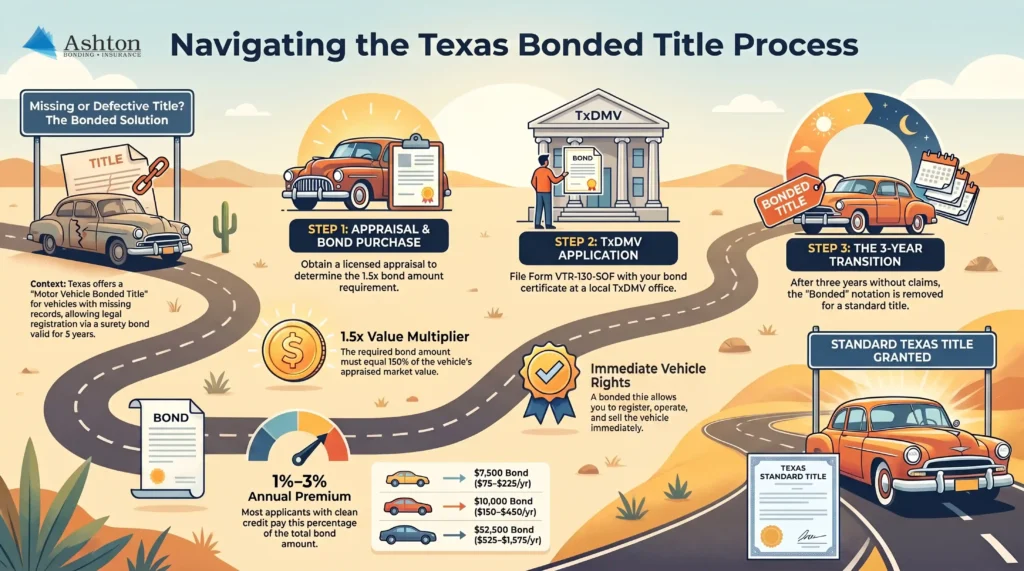
- Purchase a surety bond equal to 1.5x the vehicle’s appraised value
- Hold the bond in place for three years from the date of issuance
After three years with no claims filed, TxDMV will issue a standard Texas title without the bond notation.
How Much Does a Texas Bonded Title Bond Cost?
The bond amount is 1.5x the vehicle’s current market value. The annual premium is typically 1–3% of the bond amount.
| Vehicle Appraisal | Bond Amount (1.5x) | Estimated Annual Premium |
|---|---|---|
| $5,000 | $7,500 | $75 – $225/yr |
| $10,000 | $15,000 | $150 – $450/yr |
| $20,000 | $30,000 | $300 – $900/yr |
| $35,000 | $52,500 | $525 – $1,575/yr |
Most applicants with clean credit land at or near the low end of that range.
Step-by-Step: Getting a Bonded Title in Texas
- Get the vehicle appraised. Take the vehicle to a TxDMV regional service center or licensed vehicle inspector for an official appraisal. The appraised value determines your bond amount.
- Purchase the bond. Work with a licensed surety bond agent to purchase a Motor Vehicle Bonded Title bond. The bond must be for 1.5x the appraised value.
- Submit to TxDMV. File Form VTR-130-SOF (Statement of Fact for Texas Motor Vehicle) along with your bond certificate and supporting documents at your local TxDMV office.
- Receive your bonded title. TxDMV will issue a Texas title with a “Bonded” notation. This title is valid and allows you to register and operate the vehicle.
- Receive a clean title after 3 years. After three years with no claims, apply to TxDMV to have the bond notation removed.
Frequently Asked Questions
Can I sell a vehicle with a bonded title in Texas?
Yes. A bonded title is a valid Texas title. You can sell the vehicle, though some buyers may be cautious about the bond notation. Once the three-year period passes, the notation is removed.
What if I bought a car at a Texas auction without a title?
This is one of the most common scenarios for bonded titles in Texas. If the seller can’t provide a properly assigned title, the bonded title process is typically your path to legal ownership.
How long does the Texas bonded title process take?
Once you have your appraisal and bond, TxDMV processing typically takes 1–3 weeks. Getting the bond itself can often be done within one business day.
Do I need a Texas-licensed bond agent?
Your bond agent must be licensed to issue surety bonds in Texas. Ashton Agency is licensed in all 50 states, including Texas. Contact us to get your Texas bonded title bond →
Also see: What Is a Bonded Title? — our complete guide to the bonded title process in every state. Browse all bond types →