If you are getting your Florida notary public commission, you need a Florida notary bond before the state will issue your certificate. Florida law requires every notary to carry a $7,500 surety bond, filed with the Florida Department of State. Ashton Agency is a licensed Florida surety bond agency based in Winter Park, FL — we issue Florida notary bonds quickly, affordably, and with no runaround. See all Florida surety bonds →
Florida Notary Bond Requirements
Under Florida Statute 117.05, every notary public commission requires a surety bond. The specifics:
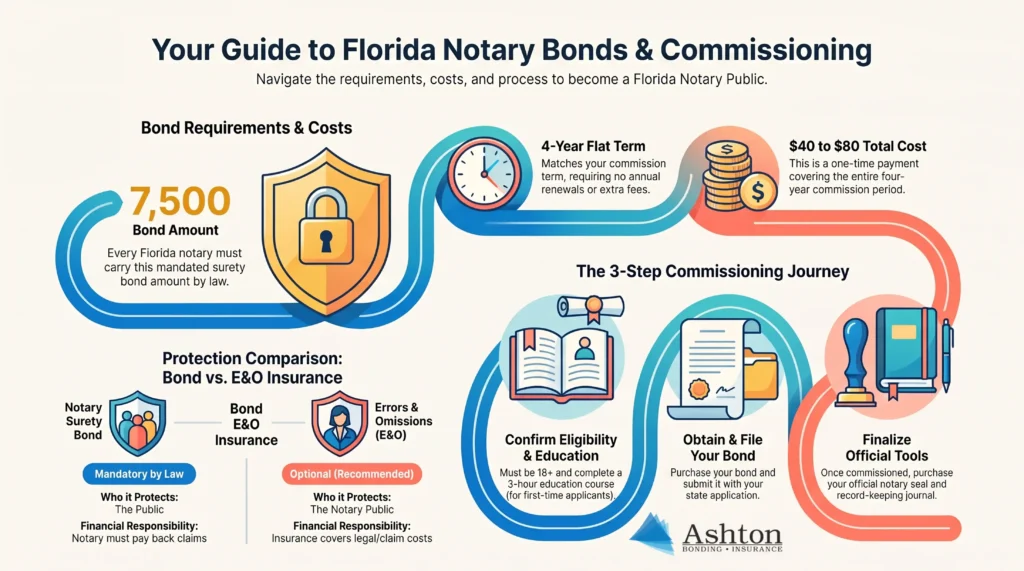
Bond amount: $7,500
Required by: Florida Department of State
Term: 4 years — matches your full notary commission term, so there is no annual renewal
Who needs it: Every person applying for or renewing a Florida notary public commission
Filing: The bond is filed as part of your notary commission application to the Florida Department of State
The Florida notary bond is one of the most straightforward surety bonds we issue — small bond amount, simple application, and one flat payment covers your entire commission term.
How Much Does a Florida Notary Bond Cost?
The Florida notary bond is one of the most affordable surety bonds available. The typical cost is $40 to $80 for the full 4-year commission term — a one-time payment, not annual.
Because the $7,500 bond amount is small and notary commissions have a very low claim rate, rates are standardized and not heavily dependent on credit score. Almost all applicants qualify at the same rate regardless of credit history.
Ashton Agency issues Florida notary bonds at competitive flat-fee pricing. Contact us and we will have your bond issued and ready to file the same day in most cases. How are surety bond costs calculated? →
How to Get Your Florida Notary Commission
The process for becoming a Florida notary public involves a few steps:
1. Confirm eligibility — you must be a Florida resident, at least 18 years old, and have no felony convictions (or have had civil rights restored)
2. Complete a Florida notary education course (3 hours, required for first-time applicants)
3. Obtain your $7,500 Florida notary bond from a licensed surety agency
4. Submit your notary application to the Florida Department of State with the bond and application fee
5. Receive your notary commission certificate
6. Purchase your official notary seal and journal
Ashton Agency handles step 3. Once you have your bond in hand, the rest of the application process moves quickly.
Florida Notary Bond vs. Notary E&O Insurance
A notary bond and notary Errors and Omissions (E&O) insurance are two different products — and many Florida notaries carry both.
The Florida notary bond ($7,500) is required by law. It protects the public — if your notarial act causes a financial loss to a third party, the bond can compensate them. You are then responsible for reimbursing the surety company for any claim paid out.
Notary E&O insurance is optional but recommended. It protects you — covering your legal defense costs and liability if a notarial error leads to a lawsuit against you personally.
The bond protects the people you serve. E&O protects you. Ask Ashton Agency about both when you get your notary commission set up.
Frequently Asked Questions — Florida Notary Bond
Is the Florida notary bond required by law?
Yes. Florida Statute 117.05 requires every notary public to carry a $7,500 surety bond as a condition of their commission. You cannot receive your notary certificate from the Florida Department of State without it.
How long does a Florida notary bond last?
Your Florida notary bond covers your full 4-year commission term. When your commission expires and you renew, you will need a new bond for the next 4-year term. Ashton Agency will reach out before your renewal comes up.
Do I need a new bond if I move to a different Florida county?
No. Your Florida notary commission and bond are statewide — they are not county-specific. You can notarize documents anywhere in Florida without needing a new bond.
What does the Florida notary bond actually cover?
The bond covers financial harm caused to a member of the public by an improper notarial act — such as notarizing a document without the signer present or notarizing a fraudulent transaction. The bond does not protect you personally from liability; that is what E&O insurance is for.
Placeholder