A bonded title — sometimes called a surety bond title or certificate of title bond — is a way to legally establish ownership of a vehicle when the original title is missing, lost, or was never transferred properly.
If you’ve purchased a car without a title, inherited a vehicle, or lost your title and can’t obtain a duplicate, most states allow you to apply for a bonded title. The bond protects anyone who might have a legitimate claim to the vehicle — a prior lienholder, a previous owner — for a defined period, typically three to five years.
How Does a Bonded Title Work?
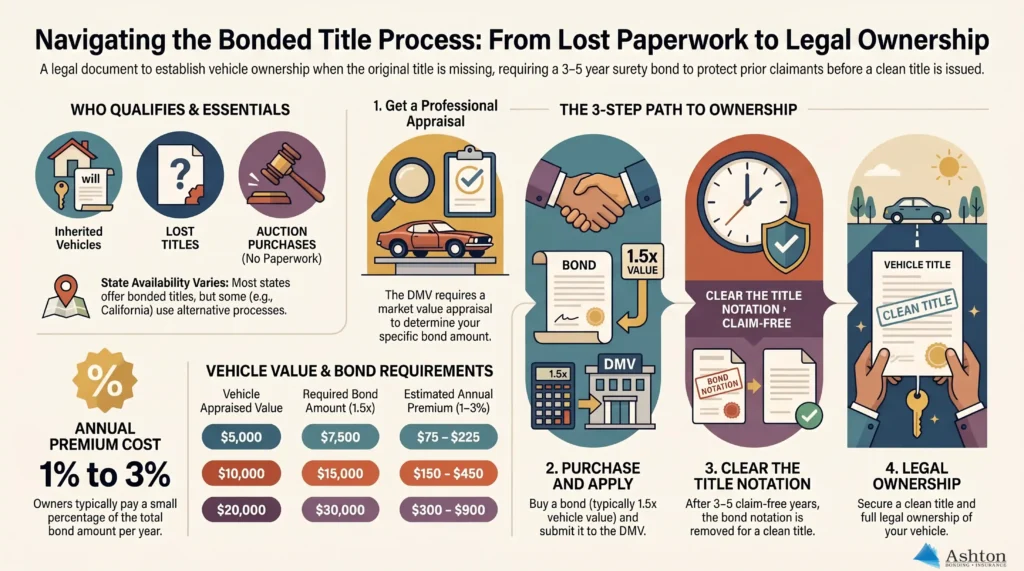
Step 1: Get the vehicle appraised.
Your state’s DMV will require an appraisal to establish the vehicle’s current market value. The bond amount is typically 1.5x the appraised value.
Step 2: Purchase a title bond.
You purchase a surety bond equal to 1.5x the appraised value. This bond stays in place for the required period (usually 3–5 years depending on your state).
Step 3: Apply for the bonded title.
You submit the bond and supporting documentation to your state’s DMV or motor vehicle agency. If approved, you receive a bonded title — a regular-looking title with a notation that it was issued under bond.
Step 4: Clear the bond.
After the required period with no claims filed, the bond notation is removed and you receive a clean title.
Who Needs a Bonded Title?
A bonded title is typically needed when:
- You purchased a vehicle from a private seller who never had a title to transfer
- A vehicle was inherited without proper title transfer
- The original title was lost and a duplicate cannot be obtained
- The lienholder is no longer in business and can’t release the lien
- You purchased a vehicle at auction without a title
Bonded Title Requirements by State
Requirements vary by state. Most states that offer bonded title programs require:
- A current vehicle appraisal (typically by a licensed appraiser or DMV inspection)
- A surety bond equal to 1.5x the appraised value
- Proof of ownership (bill of sale, prior registration, or other documentation)
- A completed title application
Some states — including California — do not offer bonded title programs and use alternative processes.
How Much Does a Bonded Title Cost?
The cost of a bonded title has two components:
- The bond premium: Typically 1–3% of the bond amount per year. For a vehicle appraised at $10,000, the bond amount is $15,000 and the annual premium is roughly $150–$450.
- State filing fees: These vary by state.
The bond usually only needs to be in place for 3–5 years, after which you receive a clean title.
Frequently Asked Questions
How long does a bonded title take?
Most bonded titles can be processed in 1–2 weeks once you have the required documentation and the bond is issued. DMV processing times vary by state.
Does a bonded title affect the value of a vehicle?
Yes, modestly. A bonded title notation may affect resale value while the bond is active, as some buyers are cautious about titled-under-bond vehicles. Once the bond period expires and the title is cleared, this is no longer a factor.
Can I get a bonded title in any state?
Most states offer bonded title programs, but not all. A few states use alternative processes for missing or defective titles. Your bond agent can confirm what’s available in your state.
Is a bonded title permanent?
No. After the bond period (typically 3–5 years) with no claims, you apply to your state DMV for a clean title with no bond notation.
Need a bonded title bond? Contact Ashton Agency — we’re licensed in all 50 states and can have your bond issued quickly. Browse all bond types →