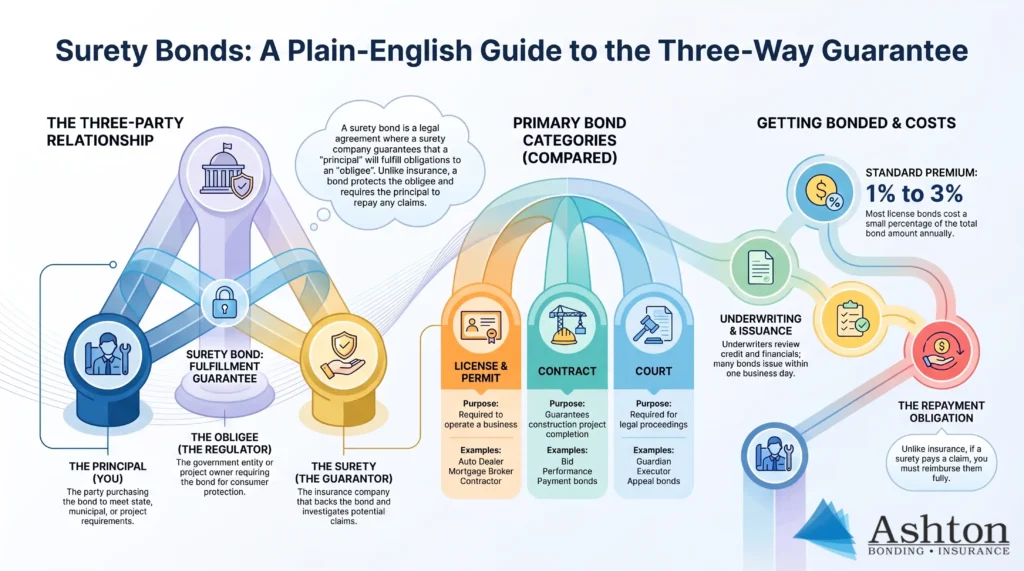
A surety bond is a legally binding agreement between three parties: you (the principal), a surety company, and a government agency or project owner (the obligee). When you purchase a bond, the surety company guarantees to the obligee that you’ll fulfill a specific obligation — whether that’s holding a dealer license, completing a contract, or meeting a state licensing requirement.
If you don’t meet that obligation, the obligee can file a claim against the bond. The surety company investigates and pays valid claims up to the bond amount. You then repay the surety.
That’s the core of it. Everything else is detail.
The Three Parties Explained
The Principal — That’s you. You purchase the bond because a state, municipality, or project owner requires it as a condition of doing business.
The Surety Company — The insurance company that backs the bond. They’re promising the obligee that you’ll perform. They vet you through an underwriting process before issuing the bond.
The Obligee — The party requiring the bond. Usually a state licensing board, the Department of Motor Vehicles, a contractor licensing agency, or a federal regulator.
How Is a Surety Bond Different from Insurance?
Insurance protects you. A surety bond protects the obligee — and ultimately the public.
If you file an insurance claim, the insurer covers your loss and the matter is closed. If a claim is filed on your surety bond, the surety company pays — but you’re required to reimburse them. A bond is closer to a line of credit backed by a guarantee than a traditional insurance policy.
This distinction matters because it affects how bonds are underwritten. Sureties evaluate your financial history, credit, and business track record before issuing a bond. The stronger your profile, the lower your rate.
Common Types of Surety Bonds
Surety bonds fall into three broad categories:
License and Permit Bonds
Required by state or local governments as a condition of operating a licensed business. These are the most common. Examples: auto dealer bonds, public adjuster bonds, mortgage broker bonds, contractor license bonds.
Contract Bonds (Construction)
Used in construction and public works to guarantee that a contractor will complete a project per contract terms. Includes bid bonds, performance bonds, and payment bonds.
Court Bonds
Required in legal proceedings — guardian bonds, executor bonds, appeal bonds, and similar instruments where a court needs financial assurance.
How Much Does a Surety Bond Cost?
Bond premiums are calculated as a percentage of the required bond amount — typically between 1% and 15% per year. Most straightforward license bonds fall in the 1–3% range for applicants with clean credit and solid financials.
For a $25,000 auto dealer bond, that’s roughly $250–$750 per year.
Several factors affect your rate: credit score, years in business, bond type, and state requirements. A good bond agent doesn’t just quote you a rate — they advocate with underwriters to find the best placement for your specific profile. See our full breakdown of how much a surety bond costs →
How to Get a Surety Bond
The process has four steps:
- Identify the bond required — Your state licensing board or contracting authority will specify the bond type and amount. Your bond agent can confirm this.
- Complete an application — Basic information about your business, personal financial history, and the bond required.
- Underwriting — The surety company reviews your application. For most license bonds, this is fast. For larger contract bonds, it’s more involved.
- Issuance — The bond is issued and delivered. For most license bonds, this can happen within one business day.
A note on the underwriting step: This is where your bond agent earns their value. A licensed agent with established underwriting relationships can advocate for better placement — meaning better rates and faster approvals — especially if your credit or business history has any complexity. An online form can submit your application. It can’t negotiate on your behalf.
What to Look for in a Surety Bond Agency
Not all bond agencies operate the same way. When you’re choosing who to work with, here are the criteria that actually matter:
Licensed in your state. Surety bonds are regulated at the state level. Your agent needs to be licensed where you operate — not just “nationwide” in a general sense.
Underwriting relationships, not just platforms. The surety market is relationship-driven. Agents with established carrier relationships can get better terms, especially for applicants who don’t fit a standard profile.
Proactive renewal tracking. Your bond has an annual expiration date. A lapsed bond can trigger immediate license suspension. The right agency tracks your renewals and reaches out before you’re at risk — not after.
Hands-on service. Bond claims are real. When one is filed against you, you want a licensed professional handling your response — not a contact form.
Depth in your industry. An agency that specializes in auto dealer bonds, contractor bonds, and public adjuster bonds will understand the specific requirements in your state better than a generalist.
Ashton Agency has been placing surety bonds since 1966. We’re licensed in all 50 states, with direct carrier relationships and a team that tracks every client’s renewal dates. Contact us to get started →
Frequently Asked Questions
What is the purpose of a surety bond?
A surety bond protects the party requiring it — typically a government agency or project owner — by guaranteeing that the bonded party will meet a specific legal or contractual obligation. If they don’t, the surety company pays valid claims up to the bond amount.
Is a surety bond the same as a license bond?
A license bond is a type of surety bond. It’s required by a state or local government as a condition of operating a licensed business — such as an auto dealer, contractor, or public adjuster. All license bonds are surety bonds, but not all surety bonds are license bonds.
How long does it take to get a surety bond?
Most license and permit bonds can be issued within one business day. Larger commercial and contract bonds may take several days depending on underwriting complexity. Working with an experienced agent who has carrier relationships typically speeds up the process.
Can I get a surety bond with bad credit?
Yes, in most cases. Some bond types have guaranteed-issue programs that don’t require credit review. For others, your credit affects your rate rather than eligibility. A bond agent can identify the best program for your situation.
How much does a surety bond cost per year?
Most license bonds cost 1–3% of the bond amount annually for applicants with good credit. A $25,000 bond typically runs $250–$750/year. See the full cost breakdown →